
Knowledge
What is photocatalysis.
Photocatalysis is a chemical reaction accelerated by light acting on a catalyst. The light supplies the energy, the photocatalyst supplies the surface — and the catalyst itself is left unchanged.
In a photocatalytic system, a semiconductor absorbs light and converts that energy into charge carriers that drive reactions at its surface. Because the catalyst is regenerated with every cycle, a small amount of material can keep working for as long as light and reactants are present.
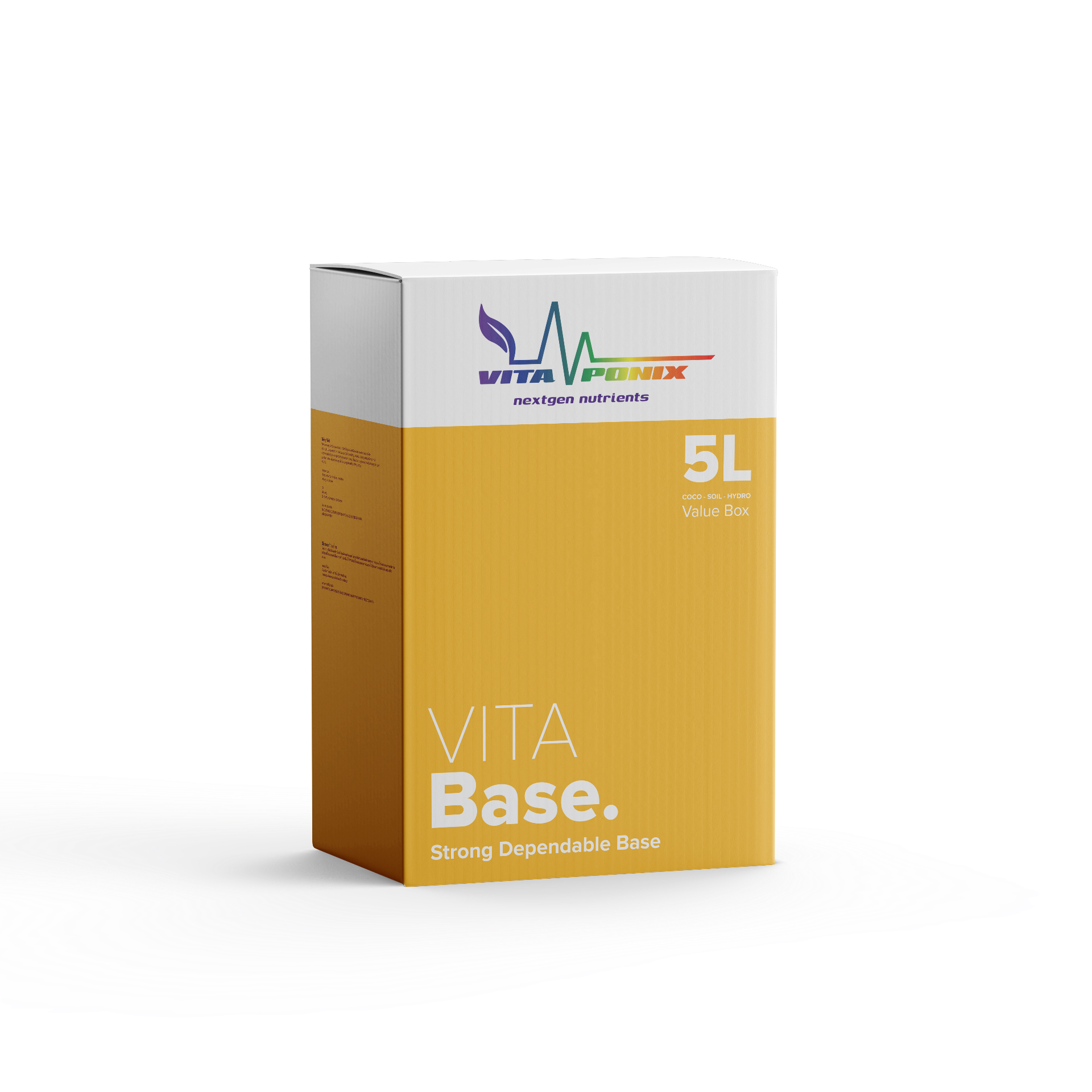
That is the mechanism behind self-cleaning glass, photocatalytic air and water treatment, and a growing part of synthetic chemistry. It is also why light quality matters in any system where mineral surfaces, water and illumination meet — including cultivation, where the underlying feed is still what sets the ceiling. Our own approach to that base chemistry lives in VitaBase, our foundational nutrient matrix.
Definition
A chemical reaction whose rate is increased by a catalyst activated by light.
Energy source
Photons — UV for TiO₂, visible light for narrower band-gap materials.
What changes
Reactants are transformed; the photocatalyst itself is regenerated each cycle.
Typical output
Reactive oxygen species that oxidise organics, or charge transfer for synthesis.
Common materials
Titanium dioxide, zinc oxide, carbon nitride, tungsten oxide.
Everyday examples
Self-cleaning glass, air and water purification, de-polluting concrete.
Mechanism
How does photocatalysis work, step by step?
01
A photon is absorbed
Light with enough energy to cross the catalyst's band gap is absorbed at the surface of the material. Nothing is consumed — the catalyst only mediates.
02
An electron–hole pair forms
The absorbed energy lifts an electron into the conduction band and leaves a positively charged hole behind in the valence band.
03
Charges migrate to the surface
Both carriers travel to the catalyst surface. Recombination competes with this step, which is why surface area and material quality decide real-world activity.
04
Surface redox chemistry happens
The electron reduces and the hole oxidises adsorbed species — commonly generating reactive oxygen species that then drive the reaction of interest.
Materials
What makes a good photocatalyst?
A photocatalyst has to absorb the available light, separate charges long enough for them to reach the surface, and stay chemically stable while doing it. Band gap sets which wavelengths are usable, surface area sets how much chemistry can happen at once, and stability sets how long the material stays useful.
Titanium dioxide remains the reference material because it is stable, cheap and non-toxic, though it is UV-limited. Zinc oxide and carbon nitride shift the usable spectrum, at the cost of stability or activity. The same logic — availability, stability and purity of the mineral surface — is why we source our minerals the way we do and why biological signaling only works on a clean elemental foundation.
Types
What are the types of photocatalysis?
Solid catalyst, fluid reactants
Heterogeneous photocatalysis
The dominant industrial form. A semiconductor — most often TiO₂ — is a solid surface that air or water flows past, so the catalyst is trivially separated and reused. Everything from self-cleaning tiles to water reactors works this way.
Catalyst dissolved with the reactants
Homogeneous photocatalysis
Molecular catalysts such as ruthenium complexes or organic dyes share a single phase with the reactants. Faster and more selective, which suits fine chemical synthesis (photoredox catalysis), but the catalyst must be separated afterwards.
Light absorber plus a separate reactant
Photosensitised reactions
A dye absorbs light and hands the energy or an electron to another species instead of doing the chemistry itself. This is the pattern behind dye-sensitised solar cells and much of photodynamic chemistry.
Whichever form is used, the deciding variable is the material. For band gap, doping, stability and worked examples, read what a photocatalyst is.
Applications
What is photocatalysis used for?
Air and water treatment
Photocatalytic oxidation destroys volatile organic compounds, pesticide residues, pharmaceutical traces and pathogens rather than merely capturing them — the mechanism behind most advanced oxidation units.
Self-cleaning and de-polluting surfaces
TiO₂-coated glass, render and paving oxidise organic grime in place and convert NOₓ into rain-soluble nitrate.
Solar fuels
Water splitting and CO₂ reduction use photocatalysts to store light energy as hydrogen or hydrocarbons. Still mostly pre-commercial, limited by efficiency and catalyst stability.
Synthetic chemistry
Photoredox catalysis enables bond-forming steps at room temperature that would otherwise need harsh reagents — now routine in pharmaceutical process chemistry.
Controlled-environment cultivation
Used on source water upstream of dosing, to reduce organic load and pathogen pressure before the nutrient solution is mixed.
The single most widely deployed of these is the oxidising route — covered end to end in photocatalytic oxidation explained, including radical chemistry, reactor design limits and where it fits around a feed.
Constraints
Why is photocatalysis harder than it sounds?
Recombination wastes most photons
Electron-hole pairs typically recombine in nanoseconds and release the energy as heat, so quantum efficiencies of a few percent are normal.
UV dependence
The most stable catalyst, anatase TiO₂, needs light below roughly 390 nm — a small slice of sunlight, which is why doping and visible-light materials are researched so heavily.
Light has to reach the surface
Turbid water, coatings, shadowing and fouling all cut photon delivery. Reactor geometry usually limits real systems more than intrinsic catalyst activity does.
Non-selective by nature
Hydroxyl radicals attack almost any organic molecule, including chelates and beneficial organics — which is why photocatalytic treatment belongs before nutrient dosing, never after it.
FAQ
What else do growers ask about photocatalysis?
What is photocatalysis in simple terms?
Photocatalysis is a reaction driven by light in the presence of a catalyst. The light provides the energy, the catalyst provides the surface where the chemistry happens, and the catalyst itself is not consumed.
What is the difference between homogeneous and heterogeneous photocatalysis?
In homogeneous photocatalysis the catalyst is dissolved in the same phase as the reactants. In heterogeneous photocatalysis — the far more common industrial case — the catalyst is a solid and the reaction happens at its surface.
What does photocatalyzed mean?
A photocatalyzed reaction is one whose rate is increased by a light-activated catalyst. The term describes the reaction, while photocatalyst describes the material doing the work.
What is the difference between photocatalysis and photolysis?
Photolysis is light breaking a bond directly, with no catalyst involved. Photocatalysis routes the light energy through a catalyst first, which lowers the photon energy needed and makes the process usable with lamps or daylight instead of high-energy UV.
Does photocatalysis work in the dark?
No. Activity stops within microseconds of the light being removed, because the electron-hole pairs that drive the chemistry only exist while photons are being absorbed. Some materials show a brief residual effect from stored charge, but it is small.
Who discovered photocatalysis?
Titanium dioxide photochemistry was studied from the early twentieth century, but the field took off after Fujishima and Honda reported photocatalytic water splitting on a TiO₂ electrode in 1972 — the result that turned it into an applied technology.
Is photocatalysis relevant to plant nutrition?
It is relevant wherever light, water and mineral surfaces meet: in oxidative water treatment upstream of a feed, and in the surface chemistry of mineral inputs. It supports nutrient availability — it does not replace a balanced base feed.
Next
Put the chemistry to work
Materials
What is a photocatalyst?
Band gap, surface area and stability: the properties that make TiO₂, ZnO and carbon nitride work as photocatalysts.
Read more about What is a photocatalyst? →
Process
Photocatalytic oxidation explained
How light-activated surfaces generate reactive oxygen species that break down contaminants in air and water.
Read more about Photocatalytic oxidation explained →
Product
VitaBase — the foundational nutrient matrix
The chelated, filler-free base feed the photocatalytic and signaling inputs are built on top of.
Read more about VitaBase — the foundational nutrient matrix →
Tool
Nutrient calculator
Build a dosed feeding schedule around VitaBase for your tank size and stage.
Read more about Nutrient calculator →